
Experiential Learning
Introduction
“Experiential learning” is an umbrella term that encompasses an array of learning experiences in and beyond the classroom, all of which emphasize learning by doing. Theorists and practitioners of experiential learning underscore its roots in a critique of traditional education modalities: students sitting in seats, a professor at the front of the classroom, a textbook presenting material, a written exam as evidence of achieving learning goals. Experiential learning replaces mediated encounters with content knowledge with direct engagement with people, places, and problems. Learning takes place as students actively engage in experiences and complete projects, then reflect on these experiences to assess what they have learned.
Experiential learning can take many forms and exist at different scales:
- An Economics professor runs an investment simulation in the classroom
- A Biology professor holds some class sessions at the campus garden to make real-life connections to key concepts
- Students in a First-Year Seminar about creativity plan and implement a day-long Festival of Divergent Thinking for local high school students
Guide
- Introduction to Experiential Learning
- Place-Based Learning
- Service-Learning and Community Engagement
What all forms of experiential learning have in common, though, is the opportunity for students to “test drive” their knowledge in either an authentic or simulated environment, receive feedback from that environment, and through guided reflection on that feedback, refine their understanding.
Foundations of Experiential Learning: John Dewey
American philosopher John Dewey (1859-1952), the founding theorist of experiential learning, posits it as a salutary corrective to the limitations of traditional education, which he characterizes in Experience and Education (1938) as a passive student receiving from a teacher preformulated ideas from the past—frequently with little connection to the student’s own life, to the present moment, or to other ideas in the curriculum—and committing them to memory. (Theorist Paolo Freire later terms this the Banking Model of education.) In place of this model of learning, Dewey proposes that students learn best through active engagement with the very things they are studying. While Dewey’s vision for experiential learning is expansive (and inspiring – Experience and Education is a bracing read), these three tenets constitute a good starting point for bringing his vision to life:
Begin with the students in front of you.
Who are they, what do they care about, and what do they already know about the subject at hand? It is the instructors’ responsibility not just to be experts in their discipline; they must connect content knowledge to the students sitting before them. Both the internal world of the student and the external world as made manifest in disciplinary knowledge must be in conversation for students to learn.
Students are active, not passive, and creative, not merely receptive, in their pursuit of learning.
For Dewey, learning is not about mastering a predetermined curriculum or canon, but about acquiring the ability to think critically and tackle challenges that arise in the course of an experience. Students learn as they work through difficulties. This feature of experiential learning connects it to the broader tradition of constructivism, a discovery-oriented approach to education whereby students’ build their own knowledge of the world, rather than having the knowledge presented to them by an instructor or a textbook.
Students learn by moving between experience and reflection.
While experiences are necessary for learning, on their own they are not sufficient. Experience must be followed by reflection. Instructors must create meaningful opportunities for students to review what they have experienced, pulling out the moments that confirm their prior knowledge as well as those that challenge what they thought they knew. Through this process of analysis, revision, synthesis, and ongoing experimentation, students learn.
It is not enough that certain materials and methods have proved effective with other individuals at other times. There must be a reason for thinking that they will function … with particular individuals at a particular time. (Dewey 46).
the educator cannot start with knowledge already organized and proceed to ladle it out in doses. (Dewey 83)
To reflect is to look back over what has been done so as to extract the net meanings which are the capital stock for intelligent dealing with future experiences. (Dewey 87)
A Map to Experiential Learning: The Kolb Learning Cycle
For the instructor looking to create experiential learning opportunities, the Kolb Learning Cycle is an indispensable guide. Building on the foundation laid by Dewey, theorist David A. Kolb (1939- ) breaks down experiential learning into four discrete but interrelated phases:
- Concrete Experience: The student has a new experience.
- Reflective Observation: The student reflects on the experience, pulling apart its different moments in order to describe what transpired in each of them as well as her reactions to events as they transpired.
- Abstract Conceptualization: The student interprets her experience, connecting it to concepts or content knowledge. This is a moment of labeling, making judgments, and drawing conclusions. The student thinks inductively to translate specific experiences into general rules or theories.
- Active Experimentation: The student plans how to test out the new rule or theory that emerges from Abstract Conceptualization. When she enacts the plan, she has another Concrete Experience and the cycle begins anew.
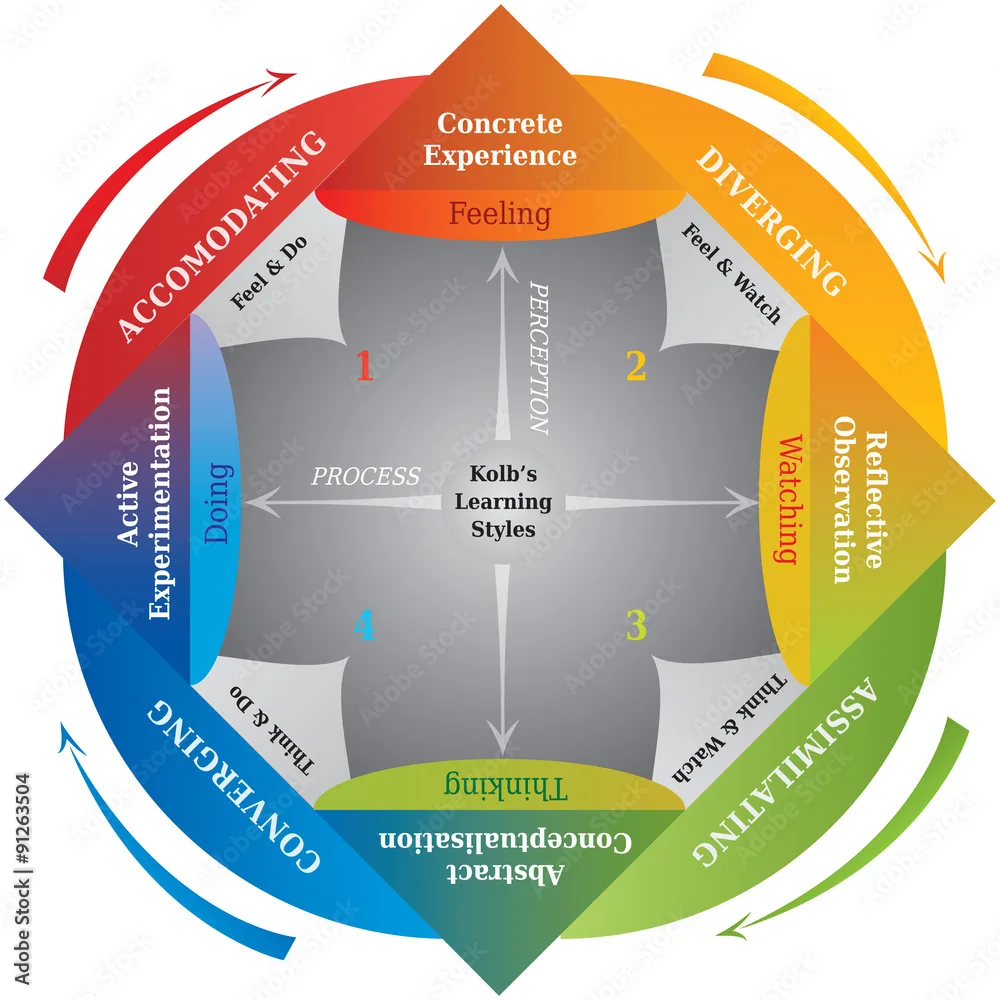
Like Dewey, Kolb stresses that students will only learn from experiences when we place those experiences within a rich reflective context, with robust opportunities for making connections, surfacing questions, and the chance to re-engage following reflection. While you can create high-impact learning experiences for students that do not incorporate the entire Kolb cycle, reflection is the critical component, even when course timing or scope does not allow for the final stages.
The following prompts can help guide your students through the cycle:
Concrete Experience
- What are your feelings as you begin, immerse yourself in the experience, and conclude?
- What are you seeing, hearing, thinking?
- What role are you playing?
- How are other people or the environment reacting to your participation?
Reflective Observation
- Can you divide your experience into different stages?
- How would you characterize each one?
- What transpired as you expected, confirming your prior knowledge?
- What surprises arose?
- How was your previous understanding challenged?
- What was difficult? What came easily?
- What are your feelings as you look back at the experience?
Abstract Conceptualization
- What terms or concepts could be used to describe your experience?
- What connections can you make to concepts, key terms, and frameworks from your academic studies?
- What do you still not understand?
- What information do you need before you engage again?
- What sources might you consult?
Active Experimentation
- What would you like to do differently when you next engage?
- What should the next step be?
- What will you need to pay attention to?
- What do you predict will happen?
Explore an example of the Kolb Learning Cycle as experienced by a hypothetical college student learning Spanish in Quito, Ecuador:
Roberta, a student newly arrived in Quito, Ecuador, is nervous about the appropriate times to use the formal “usted” form of address rather than the informal “tú” (both of which are translated as “you” in English). During the student’s first week living with an Ecuadorian family and attending classes, Roberta hears the informal “tú” used exclusively in her homestay between parents and children, and her host parents encourage her to use “tú” with them, as well. However, when students speak to their professors at the university, they use the formal, or “usted”.
When Roberta has a drink with other American students later in the week, they begin to talk about the intricacies of “tú” vs. “usted” together, relating what they’ve experienced in different social contexts.
They come to a consensus about how the formal vs informal mode of address works in Ecuador: “tú” is for people with whom you are on a first-name basis, and “usted” is for those whom you address by last name.
They try this out for a few weeks and it seems to hold true.
A month later, a young couple visits Roberta’s homestay family with their baby, and she hears her host parents using “usted” when they pick up the baby and talk babytalk to him.
Roberta wonders why and asks her friends what they think, and the learning cycle has begun again.
Frameworks for Experiential Learning
Experiential learning is a broad term that encompasses a diverse set of learning experiences that share an emphasis on learning by doing. Click on the cards below to explore different frameworks for experiential learning, each with its own intellectual history, key concepts, and literature. Note that these frameworks are not mutually exclusive: a course that features project-based learning can also incorporate service-learning and/or place-based learning. Nevertheless, each framework can be conceptualized as departing from a distinct foundational question. These frameworks do not comprise an exhaustive list—for example, this guide does not address study abroad.
As you explore below, you will find that you do not need to upend a whole course to incorporate experiential learning into it. Experiential learning can be adopted at different scales. For example, you can incorporate project-based learning or place-based learning into just one of your course’s instructional units.
Works Cited
Dewey, John. Experience and Education. 1938. Free Press, 2015.
Kolb, David A.. Experiential Learning: Experience as the Source of Learning and Development. 2nd ed., Pearson Education, 2015.